
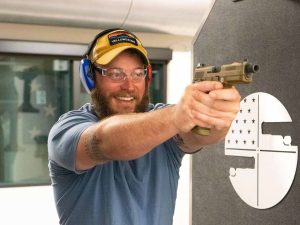

Here are a few things you should consider when choosing or building home defense guns.
When things go bump in the night, there are of course some things to consider before you start bumping back. The gun community has been a mixed bag of sorts lately with products and technology coming out at a blistering rate thanks to changes in legislature and the expansion of the broader consumer base. There are more gun owners on a much wider spectrum of diversity than ever before, and this has inadvertently led to less tribal knowledge, less general understanding of technology and a “too many cooks in the kitchen” situation with the spread of information.
Something I’ve paid a great deal of attention to in the past few years has been the growing number of so-called experts who are little more than entertainers in tactical kit. Somehow, each of these guys is former special forces, a SEAL team member, SWAT sniper … whatever. I know and work closely with all of the aforementioned characters, and most things being promoted by entertainers are just straight-up fictional, and in many cases, simply there to encourage people to buy their snake oil.
Self-defense isn’t a cookie-cutter thing, and a lot of what is being marketed to you are gimmicks. So, let’s break it down a little bit: Here are the major considerations you must address before building out a gun for your home defense needs.
The Terrain
Your home and property are a form of terrain, just like being in the woods. You have elevations, blind spots, hiding places, areas to protect and others to flee. You might think you know your home very well, but problems arise when you must think of your place as a dynamic environment that can get you killed.
Think about this: It’s dark and you’ve had a late night, watching movies with the wife. She’s doing something or other in the house, but you’re having a drink before bed and wander into the garage for a minute … and suddenly you hear a window break and she starts screaming. Where are the kids? Is this a prank? Where is your gun? You also don’t know exactly where your wife is. Is she in the bathroom down the hall or in the master bedroom? Could she be downstairs?
Your home has now become a three-dimensional space with an unknown threat. Now, you need to navigate this to keep everyone safe. It could be a bear depending on what part of the country in which you reside, or maybe a guy obsessed with your teen daughter. Predator or pervert, you’ve got to make some fast decisions.
Knowing your terrain and how to navigate in an environment where your kids will likely be awake now, confusion abounds and dangers are unknown. What you do next will be important. Locating your family members is critical—bullets don’t care who is behind that thin sheet of drywall. Homes are very easy to shoot through. You can’t just start shooting until you are line of sight with a threat, and that can be difficult in any structure.
Knowing your layout, location of weapons and the locations of your family members are very critical to keeping everyone safe. Once a gun is in play, your structure is no longer safe for anyone; it’s the fact of firing in a home. Even if they are directly behind you, the danger of incoming fire is present as well. You need to find places you can defend that also don’t endanger your loved ones, which can be difficult in most homes.
So, with all this front of mind, are you building out a home gun because you like it … or because you’ve done the homework and it’s suited to your specific home terrain?
Caliber and Size
It’s my belief that any self-defense pistol set up for use in the home should be able to be operated at least by the adults in the household, and the older children should have general knowledge and training with it as well. In general, this means that whatever pistol I set up should feature ambidextrous controls. For instance, many members of my family are left-handed, whereas I am right-handed. Any gun used for defense should at least be able to be trained on with the weak hand. Many pistols out there today are effectively ambidextrous; this set of features is no longer difficult to find.
There is a prevailing belief that “nightstand” pistols can be larger and more powerful, but I don’t agree with this. Being easy to handle and fire is much better than greater power. If your wife has a hard time operating a semi-automatic pistol, but has an easy time with a revolver, a revolver should be what you train and practice with. If you’re incapacitated or shot, the last thing you want is your wife unable to chamber a round or manipulate all the controls.
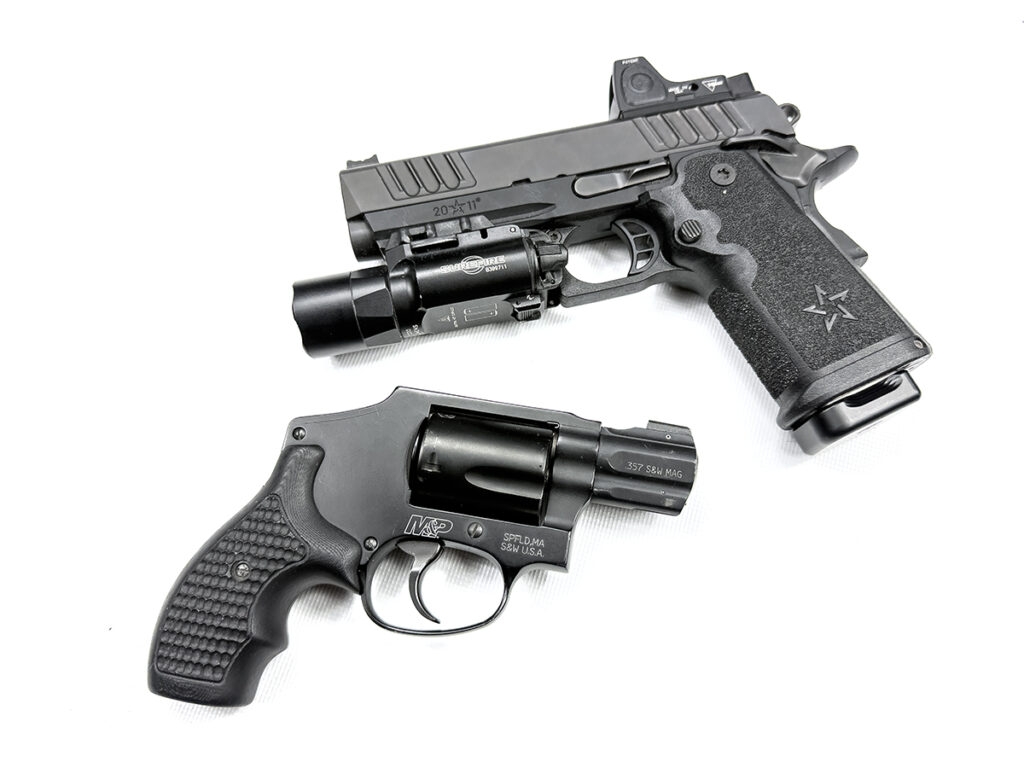
Suppressors on pistols in the home … well, I’m not convinced it’s a smart move. As suppressors are gaining popularity, they have definitely found their way onto home defense pistols, but it’s not all roses. I am not a big fan of them from the perspective that they tend to add a lot of forward weight, are harder to point and handle, and can adversely affect reliability. As a generality, they are going to basically double the length of your pistol, and suppressors, while reducing noise, can interfere with lights and optics. If you want to do this, you need to spend a lot more time practicing and training with your setup … in the dark.
Onboard Technology
Take note: Smoothly operating technology is something that is more important than the most advanced technology. If you are equipping your pistol with a red-dot, light and all the bells and whistles, it better not be too complicated to use if you are incapacitated. There is absolutely nothing wrong with a regular 1911 and a flashlight; you’ve been coerced into believing that all of the stuff needs to be in one place.
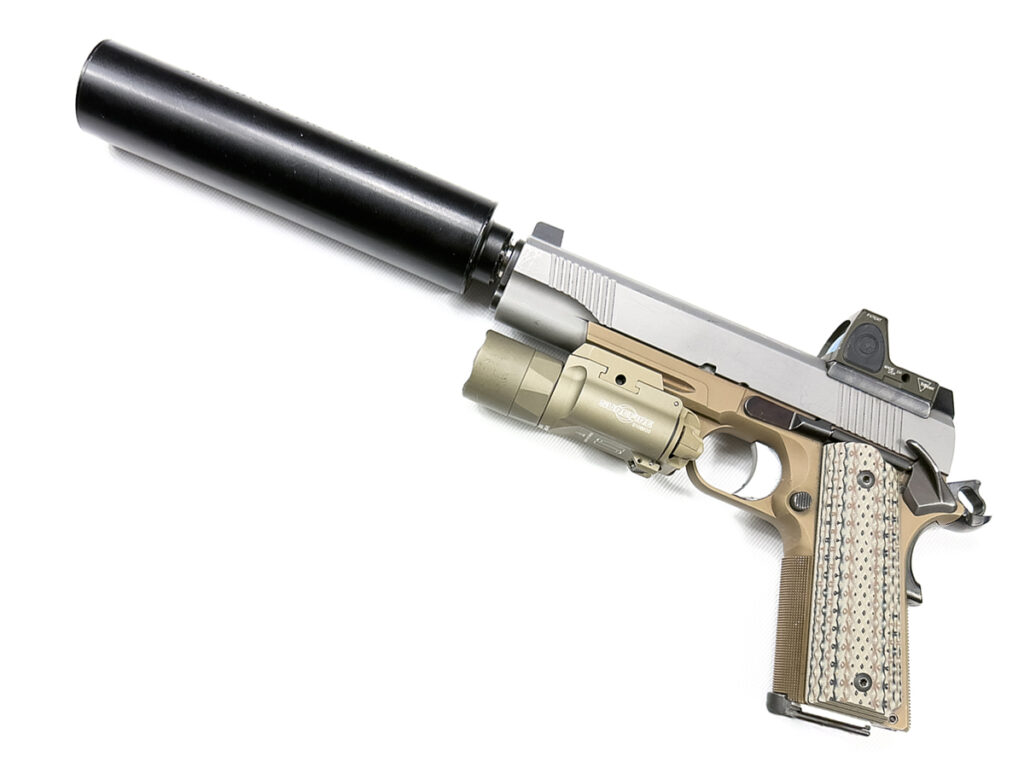
The shooting industry, unfortunately, does a good job gaslighting people into buying more products because that’s what instructors in the military use, but you’re not going to have the support of those people or that military industrial complex when something bad happens at your house. If it’s too complicated for all of your family members to use, don’t use it. If your wife has a hard time using a pistol-mounted red-dot, don’t use it.
I don’t have the answer for what’s best for you. But I can tell you that overdoing it is a recipe for disaster, considering that there is a steeper proficiency curve the more items you add onto your pistol.
Safety Features and Storage
A big part of owning a gun is being safe about it. Just like racing to put all of the possible accessories onto your gun is something of a fool’s errand, if you can’t master the basics, getting all that equipment and then simply leaving it in a drawer unattended is a pretty bad option—even if it’s just from an investment standpoint.
As mentioned, complicated features can lead to liabilities, but complicated storage can lead to inaccessibility. There is a pretty wide margin between leaving a loaded pistol out in the open and leaving it empty in a safe. Today, there are quite a few options for safe storage, and our community has been slowly embracing them, among these are keypad and biometric options that allow quick access but remain secure. These are not exactly gun safes and should not take their place, but they do keep unwanted users from gaining immediate access. I strongly recommend looking into options from Hornady.
Additionally, there’s a bit of a debate about manual safeties and their advantages … and disadvantages. Most striker-fired pistols don’t have an easily verifiable way to show if the pistol is loaded or empty. Guns that have both striker fire mechanisms and manual safeties are not as common as those that have exposed hammers, such as a 1911. It’s very easy to, even from a distance, see if the 1911 is ready to fire.
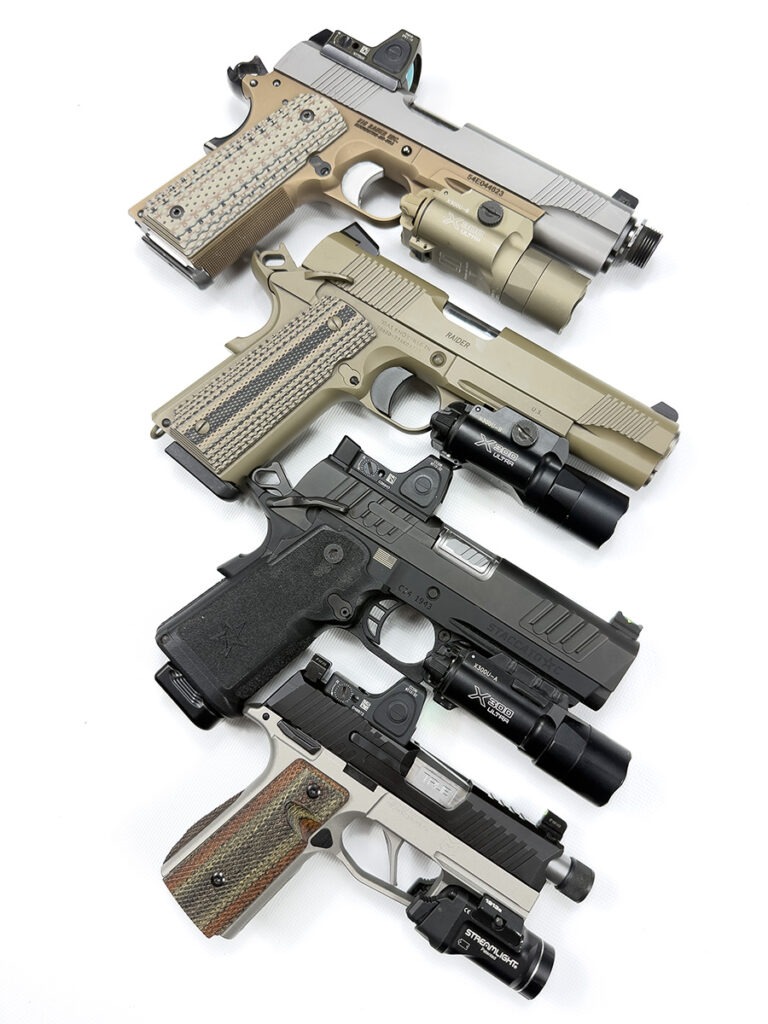
Manual safeties are definitely a bonus for safety in the home; however, they are one more thing to keep in mind under stress. You will find that there are a variety of schools of thought that go into this, and at the end of the day you’re going to have to figure out what’s best for you and your family.
The Big Question
Home defense rifles are not a new concept, but their expanding popularity in recent years has led to a lot of disinformation. A big one I hear is that 5.56 NATO is not “good at penetration” and is pretty safe to use in a standard residential structure. I’ve even heard from experts that it’s safer to use than high-mass pistol rounds, such as 9mm or .45 ACP. This is simply not true.
A 5.56 NATO bullet can and will penetrate walls. It’s an absolutely serious, lethal, high-penetration cartridge (as always, bullet dependent) that can very easily do damage several rooms over.
The same concepts apply to shotguns: Shotguns are some of the worst offenders for multi-wall penetration. Despite the fact that they have been the quintessential home defense firearm for generations, it’s the fact that they have been around so commonly that led to this, not out of any real purposeful design. If a shotgun is what you have, again, training and situational awareness are paramount.
Any rifle cartridge you use is going to be considerably more powerful than your home materials can withstand—7.62×39, .308 Winchester, 6.5 Creedmoor, you name it. A while ago on these pages, I wrote about a concept that I dubbed Schrodinger’s bullet, where we basically ask a bullet to kill a bad guy, but not cause excessive penetration in walls or create liability for nearby individuals. We are asking too much of bullets if that’s the case. There is no such bullet that will simply stop in a bad guy that can’t first make it through clothing to his vital organs.
Your home defense setup can and will kill your family members or neighbors by accident. Expect any home defense setup to go through walls—period.
Watch Your Weight
Many shooters have become obsessed with taking up every bit of real estate on a long-gun these days. I tend to trick out my field rifles. I simply like good-looking guns. However, I would be lying if I told you that these were ideal setups for home defense.
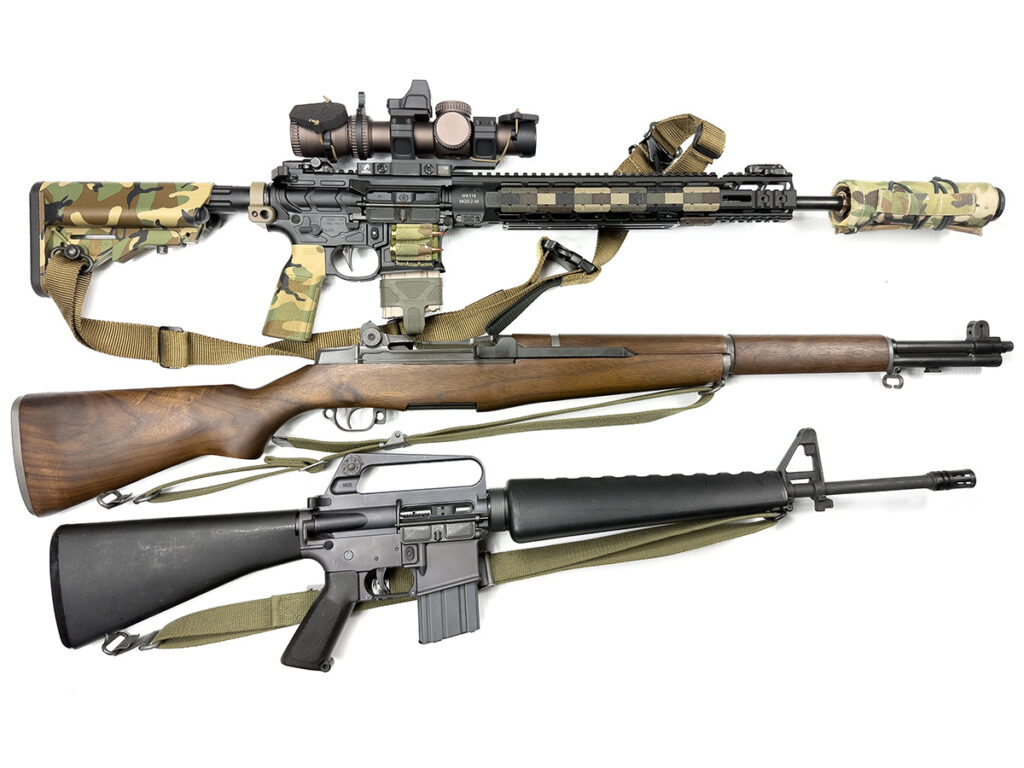
The rifle featured in this article is a PWS chambered in 6ARC and features an 18-inch barrel, a suppressor, a thermal optic from Armasight and a day optic package from Vortex. This rifle, loaded, weighs 16 pounds and is a rifle I used for hunting and usually off of a tripod. Despite the fact that it looks like a useful setup, it’s not easy to move around the home with. The optics on this rifle alone account for several pounds, and the suppressor adds weight and length to the front of the rifle.
It used to be taught that you wanted a compact package that you could operate off of either shoulder, and it would be light and handy. Most of my friends’ home defense rifles are so encrusted in gear that they’re approaching boat-anchor territory. The overly commercialized industry and gear-junkie instructors would have you preparing to invade Afghanistan again with what is commonly being pushed.
On the other hand, a bone-stock M16 A1 weighs less than half of this despite being “outdated.” In our day and age, iron sights are often completely overlooked for more complicated optics. However, in doing shoot houses and other training exercises, there is no real difference in speed between dots and irons inside close quarters. But I did notice LPVO optics are decidedly slower, yet do offer advantages the second you enter open areas. Weight as a consideration needs to be addressed: The more you add to a rifle, the harder it will be to operate by family members.
Less clutter and more function are exactly where you should start.
Slings and Things
There is debate around accessories like slings on rifles and shotguns for the home. I’ve heard both camps, and I can see all the sides. One says yes to slings because you can have a gun handy if moving kids or an injured person. On the other hand, they are easy to catch on things, grab onto and can generally snag easily while moving.
This is one you’re going to have to determine for yourself, but my middle ground is to have a sling that is tightly secured to the gun but easily deployed. Likewise, it would be a good idea to attach a tourniquet to the stock as well.
Lights and lasers are a mixed bag. A good defensive carbine is benefited by a light, although it does give your position away and can wash out optics in closed spaces. I’m not a big fan of lasers, as visible day lasers are not as fast or easy to use as you might expect, and infrared lasers require you to cut your power and put on your NVDs. I know some guys who do, but it’s a lot to go through when you’re already in an emergency and seconds count.
Preparing for Reality
If you’re a student of history or are the victim of your upper-level management handing out copies to promote sales strategy and synergy in the office, Sun Tsu’s The Art of War talks about the need to prepare accordingly for conflict, not about every kind of sword or spear. While the book could more easily be summed up as a collection of common-sense anecdotes repackaged for sheepdog guys to start PowerPoint presentations, there is a shocking lack of basic common sense in home defense instruction and training.
We’ve been looking at the wrong things in the wrong ways, and it’s a shame. You should be building a gun for your own exact reality, not warfare or team exercises despite how cool they look. Traumatic injury training is lacking virtually everywhere. Common sense says you have a weapon that causes harm, yet we don’t emphasize that angle.
Take a minute and look at your terrain, your rooms, and your strong and weak points. Think about whether you’d have to carry a child or if you get stabbed. Where are your medical supplies? Do your kids know how to stop bleeding? What if your toddler is shot? Grim, right? That’s reality, and adding more accessories to your gun isn’t going to teach your wife to pack a gunshot wound with underwear.
Building a gun is the last thing you need to worry about in defending yourself—surviving is. Your guns should be simple, reliable and not just for you. You might be the one who needs defending in the end.
Editor’s Note: This article originally appeared in the April 2026 issue of Gun Digest the Magazine.
More On Home Defense
Next Step: Get your FREE Printable Target Pack
Enhance your shooting precision with our 62 MOA Targets, perfect for rifles and handguns. Crafted in collaboration with Storm Tactical for accuracy and versatility.
Subscribe to the Gun Digest email newsletter and get your downloadable target pack sent straight to your inbox. Stay updated with the latest firearms info in the industry.
Read the full article here