
Images by the author
Even though I came to the bolt action rifle table a bit later in my life, I had been aware of the Scout rifle concept as envisaged by gun guru Jeff Cooper for decades. I just had no way to own one, nor a reason to.
In more recent years, since becoming a writer, doors have been opened that were closed before. Also, Indiana changed its deer firearms season laws, and now almost everything from .219 up in bullet diameter is permissible.
Those doors swung wide open. (It’s going to take an effort to decide whether to hunt with this Scout 308 or my suppressed AR 5.56 from HM Defense… that is one fun, quiet gun! I guess I could always put a suppressor on the Scout…) But I digress.
Scout Rifle?
A Scout rifle, as designed by Jeff Cooper in the early 1980s, is meant to be handy, effective, and quick into action, with a low-power, long-eye-relief scope mounted forward and rear-aperture, front-post backup sights installed. We might think of a mountain or a hunting guide’s rifle in similar terms. His idea was that you should be able to use the open sights to hit targets at 500 yards, but have an optic, also. Cooper’s rifle was meant to be chambered in .308 Winchester… hence the “effective” part.
Here are a few defining characteristics of the Scout rifle:
- Caliber: .308
- Action: bolt
- Trigger: Clean, 3 pounds
- Barrel: No longer than 19 inches; shorter is better
- Weight: Should be less than 7 pounds, with 8 as a maximum
- Length: Overall length of no more than 39 inches
- Optics: Forward-mounted scope, no more than 2-3 power
- Reserve Sights: Ghost ring rear, front post
- Stock: Synthetic, not wood
- Magazine: A box magazine with a double detent to allow both feeding and non-feeding positions
- Sling: “Ching” or “CW” sling that allows both carry and to use as an aid when shooting
- Accuracy: 2 MOA
It was with great anticipation that I learned that Ruger had revisited the Scout rifle concept. They made their original Scout in 2011 with the Gunsite Scout rifle. This Model 77-based, wood-stocked bolt-action was chambered in .308. It was created as a tribute to Cooper’s Gunsite firearms training facility.
Other companies have made Scout rifles… notably Steyr, Savage, Mossberg, and Howa. It is a popular category.
This Rifle
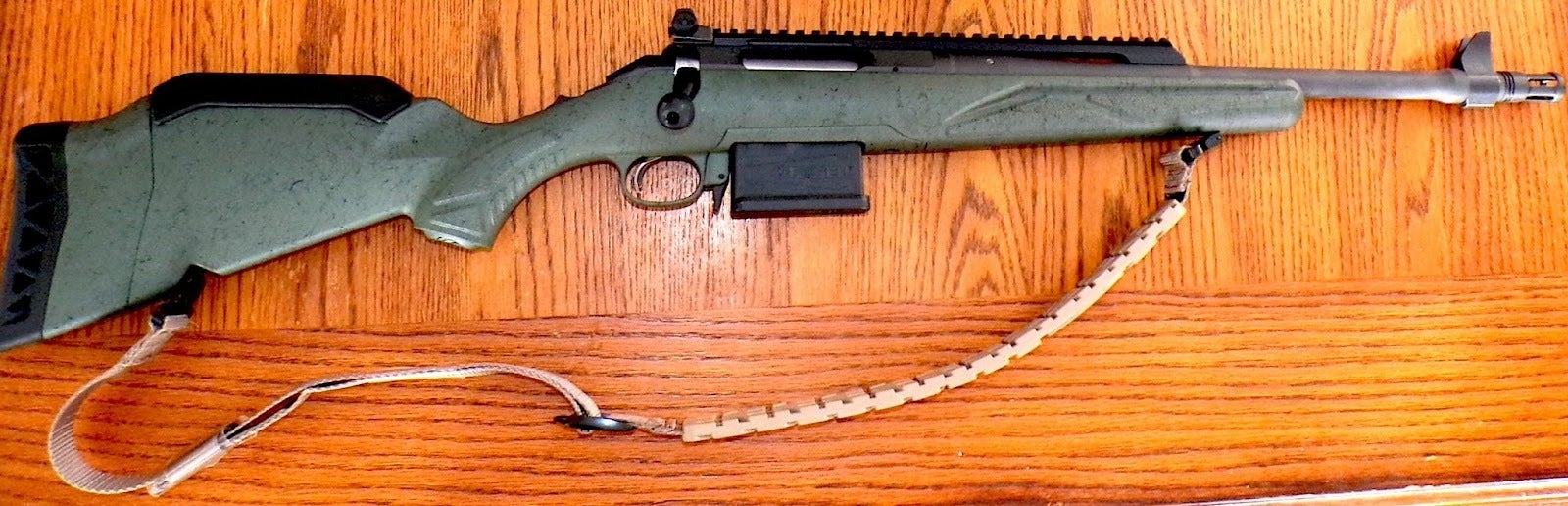
OK… now you’re up to speed on the Scout concept. Let’s look at this specific rifle. First, here are some specifications and features. Then, we’ll see how closely it lines up with the above Scout characteristics.
Specifications
| Stock: | Leaf Green Gen II American |
| Barrel: | 16.1”, 5 grooves |
| Barrel Finish: | Cobalt Cerakote |
| Muzzle Thread Pattern: | ⅝”x24; A2 flash hider installed |
| Weight: | 6.5 pounds |
| Capacity: | 5 |
| Magazine: | Type AI-style |
| Front Sight: | AR-style, adjustable |
| Rear Sight: | Windage adjustable with flip aperture |
| Material: | Alloy steel |
| Twist: | 1:10”, RH |
| Trigger Pull Weight: | 4 pounds, 1 ounce measured |
| Overall Length: | 37.35” |
| Length Of Pull: | 12” to 13.75” |
| Suggested Retail: | $929 |
Here is more information from the Scout’s web page. Sorry about the copy/paste, but these features are good to know…
- AR-style pin and aperture iron sights offer both elevation and windage adjustment. In addition, the rear aperture has two flip-adjustable sizes for near and far sighting.
- Factory-installed, Scout-length scope base for mounting intermediate eye relief scopes, optics, and night vision or thermal imaging devices.
- Splatter finished stock provides excellent grip without being too sharp or abrasive.
- Soft rubber recoil pad features a large radius on the heel for easy shouldering and improved geometry that progressively collapses to reduce felt recoil.
- Removing the installed spacer allows for the length of pull to be adjusted from 13.75″ to 12″. Additional spacers of varying sizes for a more refined fit are available at ShopRuger.com.
- Low comb (included) allows for improved sight alignment when using magnified optics, but can be left off when utilizing factory-installed iron (not plastic!) sights. More comb options are available at ShopRuger.com to further refine the fit.
- Professionally applied Cerakote coating on barrel, receiver, and bolt handle results in a durable, easy-to-maintain finish.
- Compact, threaded barrel with factory-installed flash suppressor is cold hammer-forged, resulting in ultra-precise rifling that provides exceptional accuracy and longevity.
- Intuitive three-position tang safety locks the bolt, preventing inadvertent bolt opening while allowing the rifle to be loaded with the safety engaged.
- Ruger Marksman Adjustable™ trigger offers a crisp release with a pull weight that is user-adjustable between 3 and 5 pounds.
- Patented Power Bedding™ integral bedding block system positively locates the receiver and free-floats the barrel for outstanding accuracy.
- The one-piece bolt is CNC machined from stainless steel for smooth operation, and the familiar three-lug design with 70° throw provides ample scope clearance.
- Oversized bolt handle for positive bolt manipulation, with a 5/16″-24 thread pattern for easy replacement.
- The available accessory stock weight kit adds up to 1.6 pounds to the butt of the rifle to absorb recoil and improve the rifle’s balance when utilizing heavier muzzle devices. Weight kit available on ShopRuger.com.
- Includes: one magazine; steel sling swivel studs.
So, to compare this rifle with the Scout characteristics listed above, we see that it qualifies in the following areas:
- Bolt action ✔
- Weight ✔
- Stock ✔
- Caliber ✔
- Overall length ✔
- Trigger ✔
- Sights ✔
- Accuracy ✔
Looks like Ruger’s engineers ticked most of the right boxes.
At least one difference exists between Cooper’s vision and the rifle on the table in front of me: the bolt. Cooper specified that the bolt should be built on the Mauser two-lug pattern… I assume for simplicity’s sake, plus strength. The Ruger bolt uses a three-lug pattern, like many modern rifles. To my mind, this is something that has come about because of modern engineering and is not a deal-breaker. The rifle locked up easily and performed perfectly, and the three-lug bolt throw doesn’t interfere with whatever scope you’ve mounted.
A word about optics… back in Cooper’s day, we had no red dots or low-power variable-optic scopes. He included as a part of his specifications a 2x-3x long eye relief scope (similar to the 4x Leupold M8, which was designed for handgun use) as being the preferred optic. Today, we have many choices that fulfill that scope-forward requirement. You don’t need to use a dedicated long-eye-relief scope… just put your favorite red dot or LPVO on it and head to the range. Or, don’t put anything on it and just use the included ghost ring/post setup. That’s how I shot the targets below.
Photos
Let’s look at some photos I took.
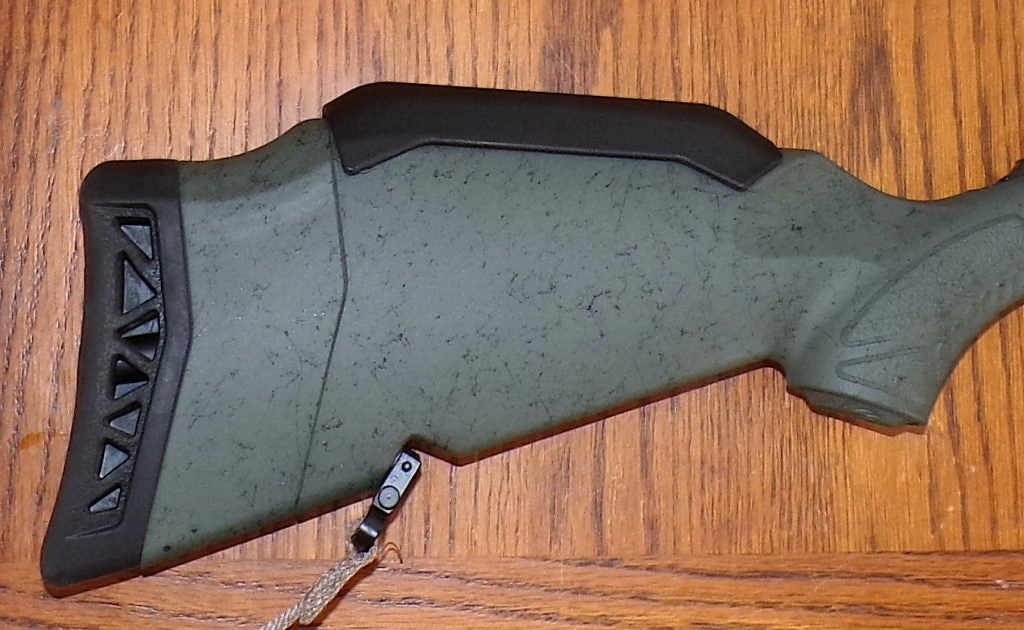
Here we see the nice recoil pad, the removable extension to shorten the length of pull, and the removable comb extension.
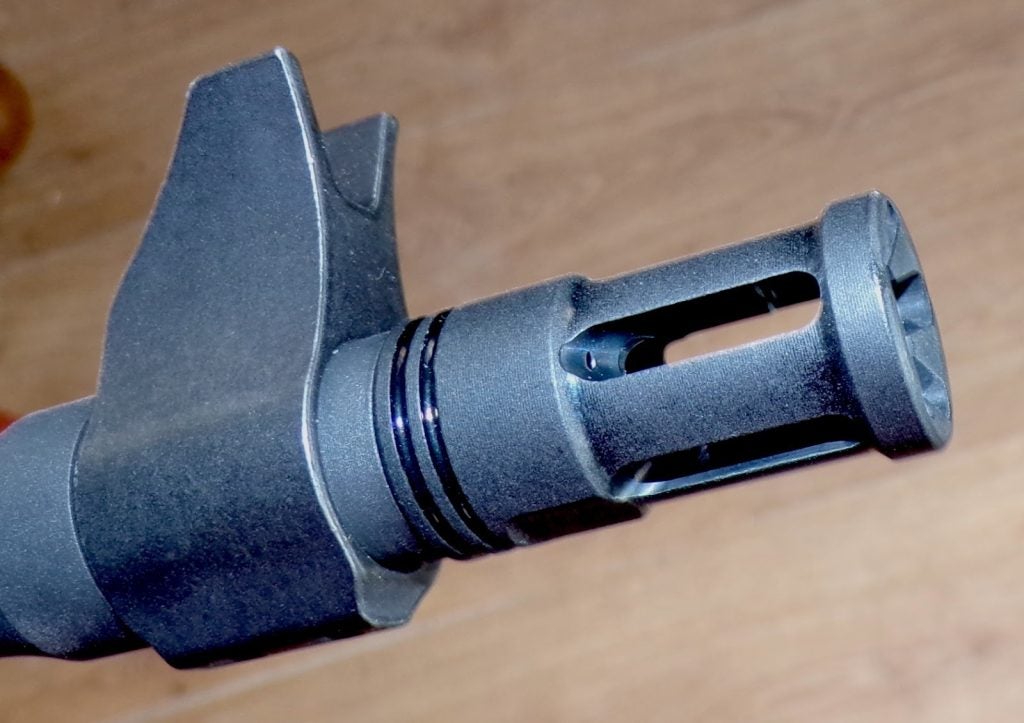
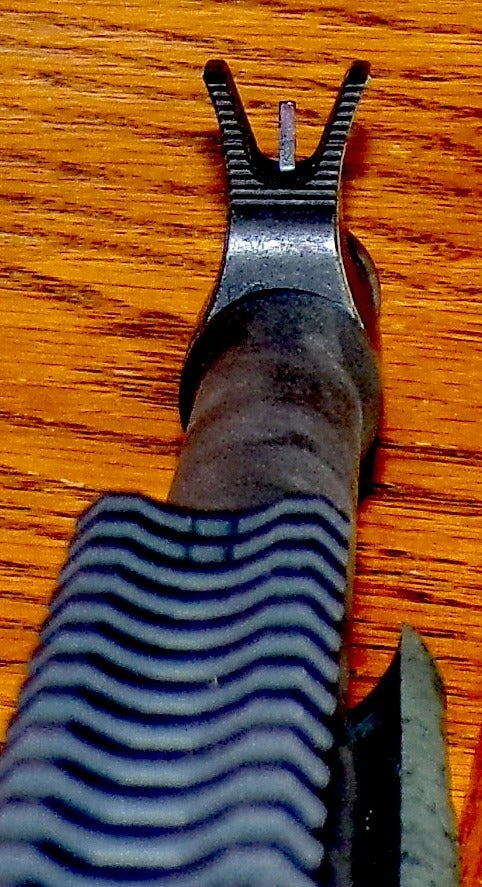
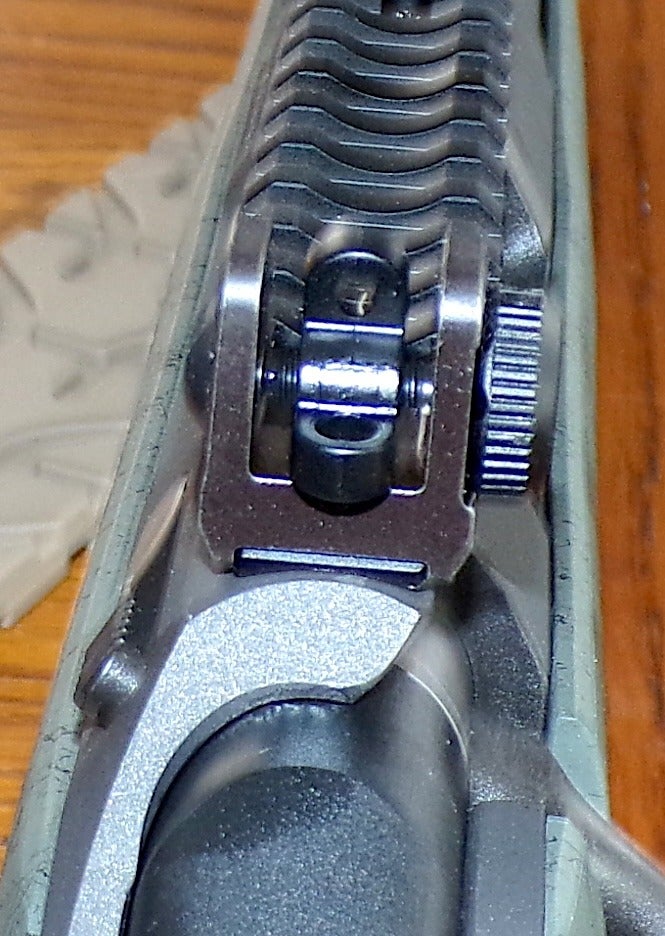
The flash hider and sights. You have the typical flip aperture and AR-style front post.
The tang safety is easy to reach, and is positive in its engagement…
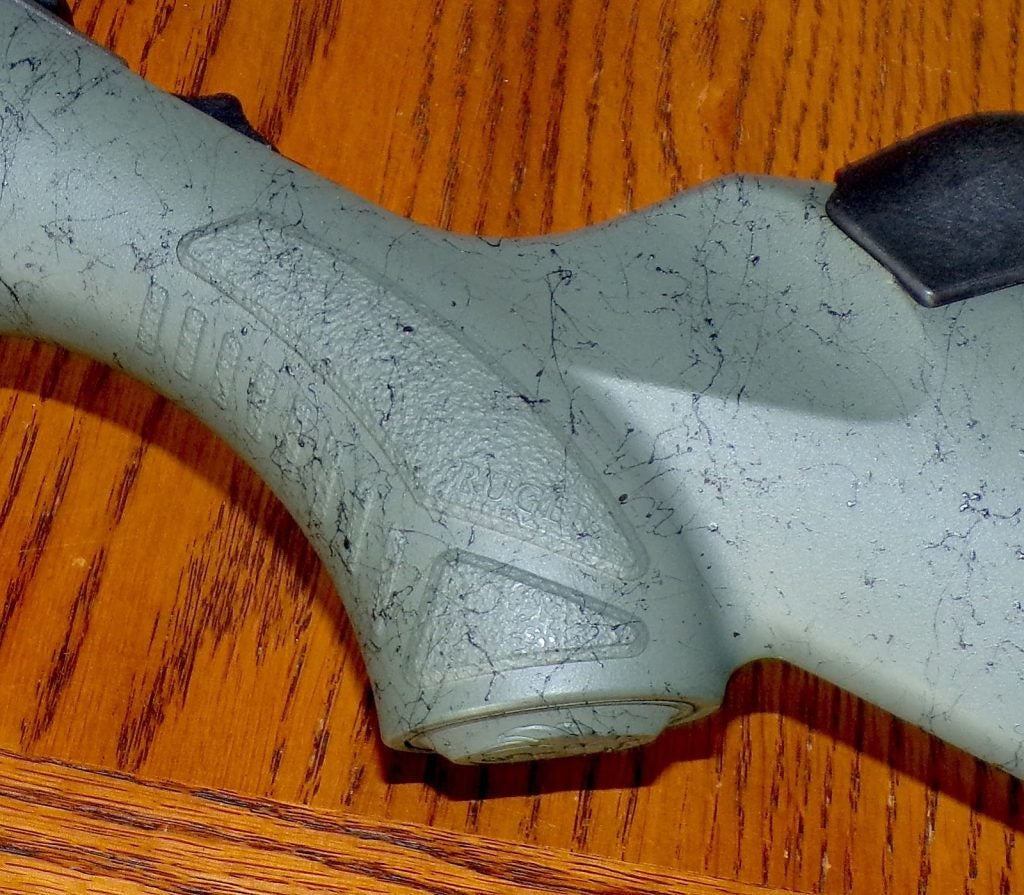
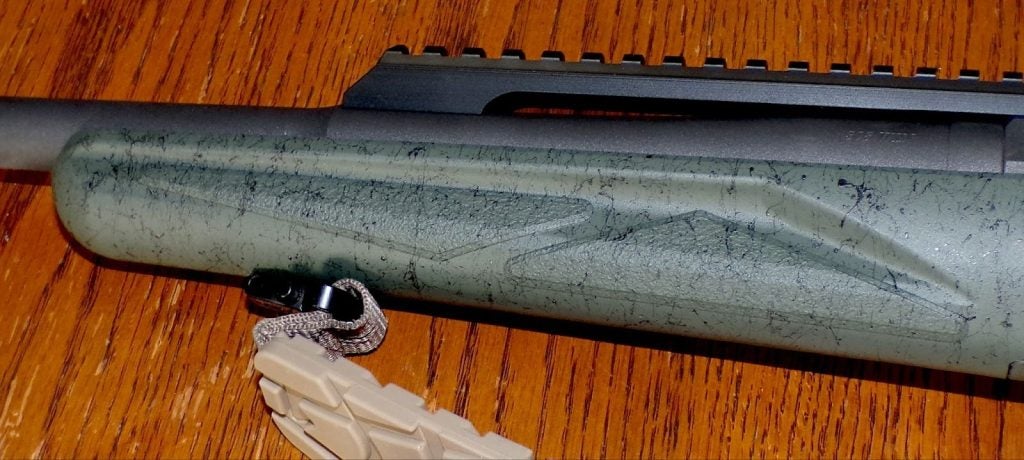
The American Gen II stock texturing is just enough.
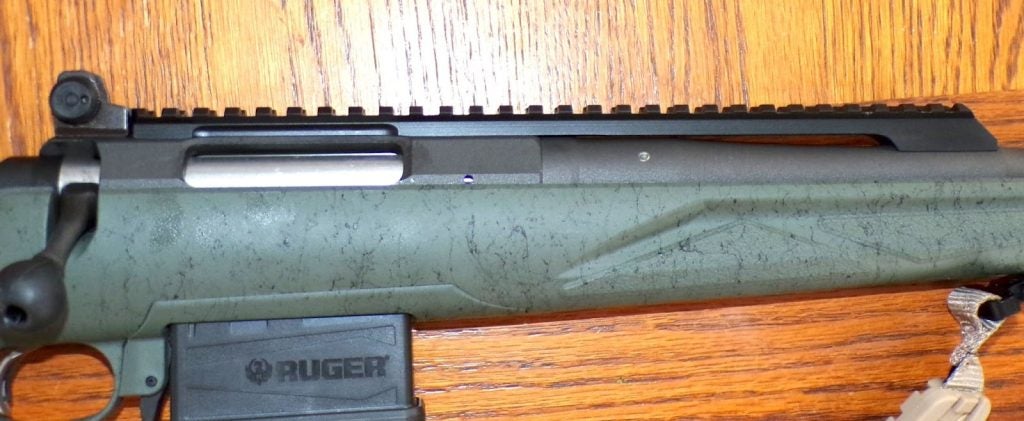
The Pic rail is long enough to mount just about whatever you want.
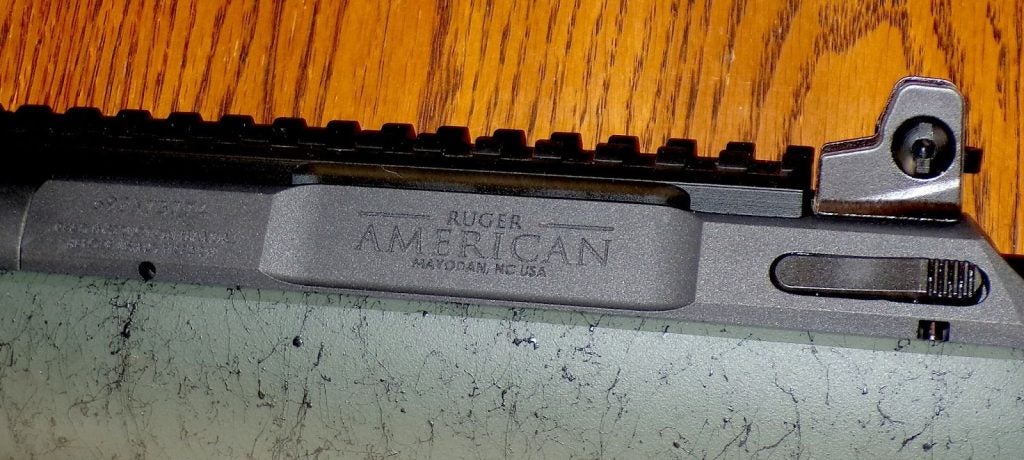
Logo, sight, and bolt release. The bolt comes out easily enough for cleaning.
Range Time
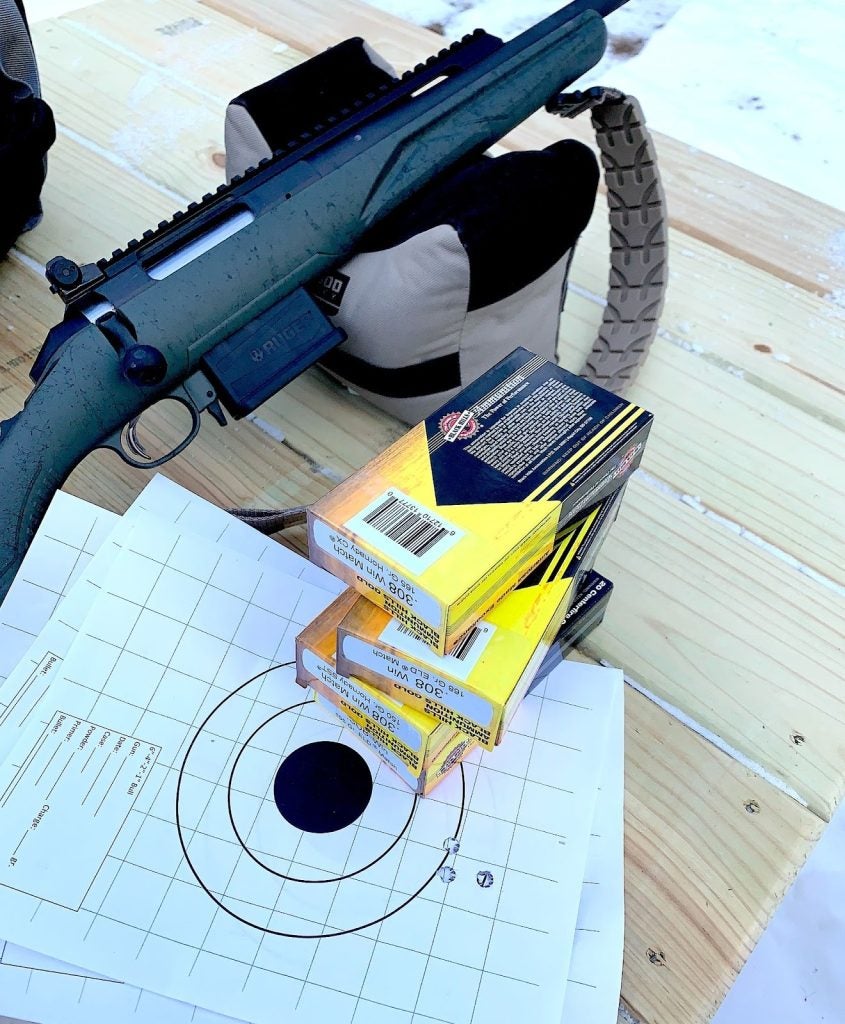
Before I stick pics of targets here, I need to explain that, due to the horrible weather that most of the country recently “enjoyed”, I was only able to get to about 50 yards in my backyard range. We got more snow at one time than I can ever remember getting throughout most of my long life. That wasn’t bad enough, but the daytime temps hovered in the single digits with a goodly wind blowing, and below-zero wind chills. So much for my excuses, but I did the best I could considering the conditions. And the only local indoor range for miles around frowns on .308…
Black Hills supplies my review ammo, for which I am extremely grateful. They sent four .308 loads, all yellow-box Gold ammo. They were:
- 150-grain Hornady SST
- 155-grain ELD Match
- 165-grain Hornady CX
- 168-grain ELD Match
To say that these loads are at the top of the heap is an understatement. Black Hills makes some fine ammo not only for civilian shooters, but they also sell to law enforcement and military procurers. This is good stuff, indeed, and I have a firm suspicion that it is better than I am able to shoot it.
Here are four representative targets, shot with the aperture/post sights that came on the gun. I do need to move the front post and rear aperture to dial in the point of impact, but that will happen soon.
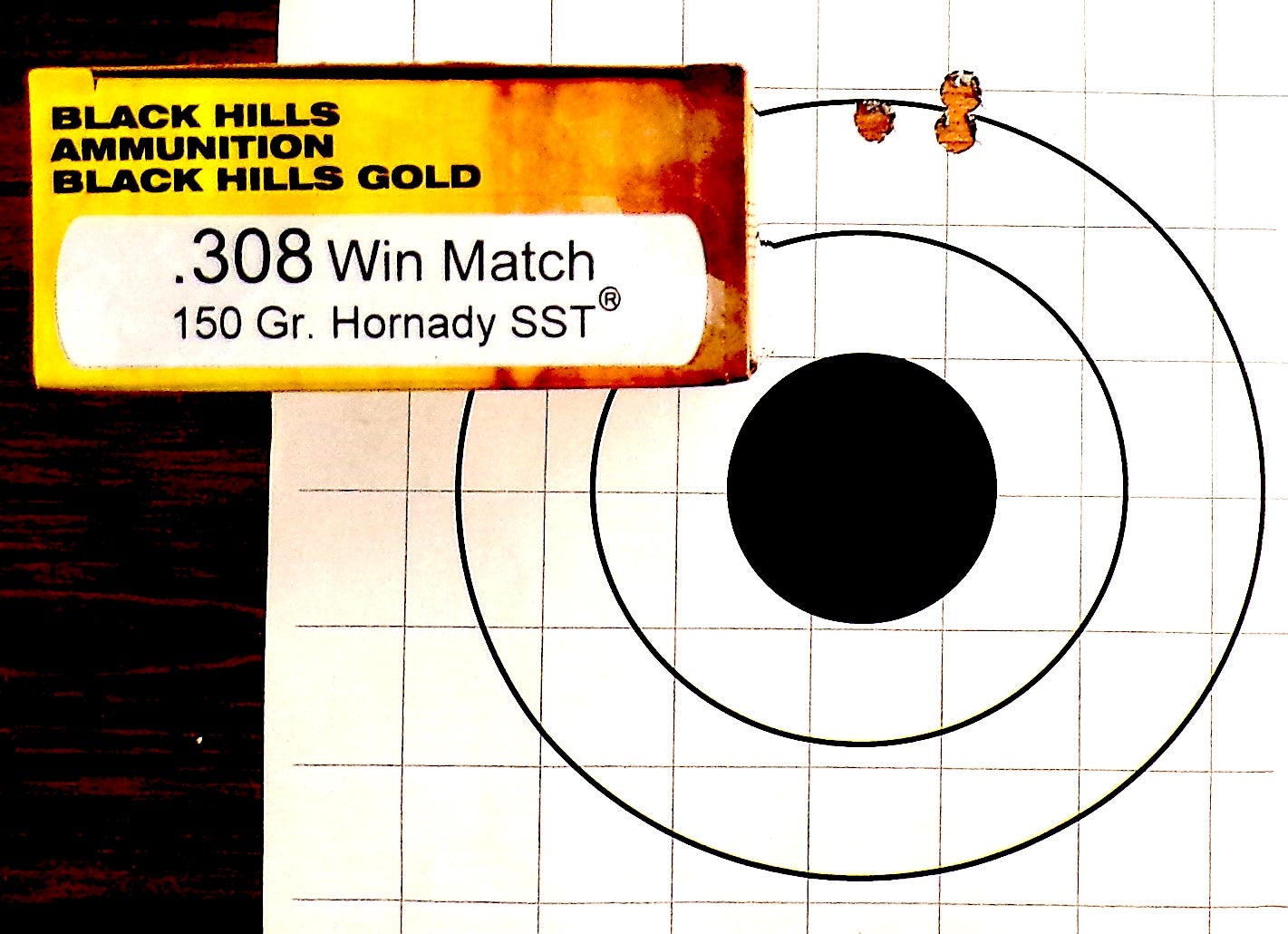
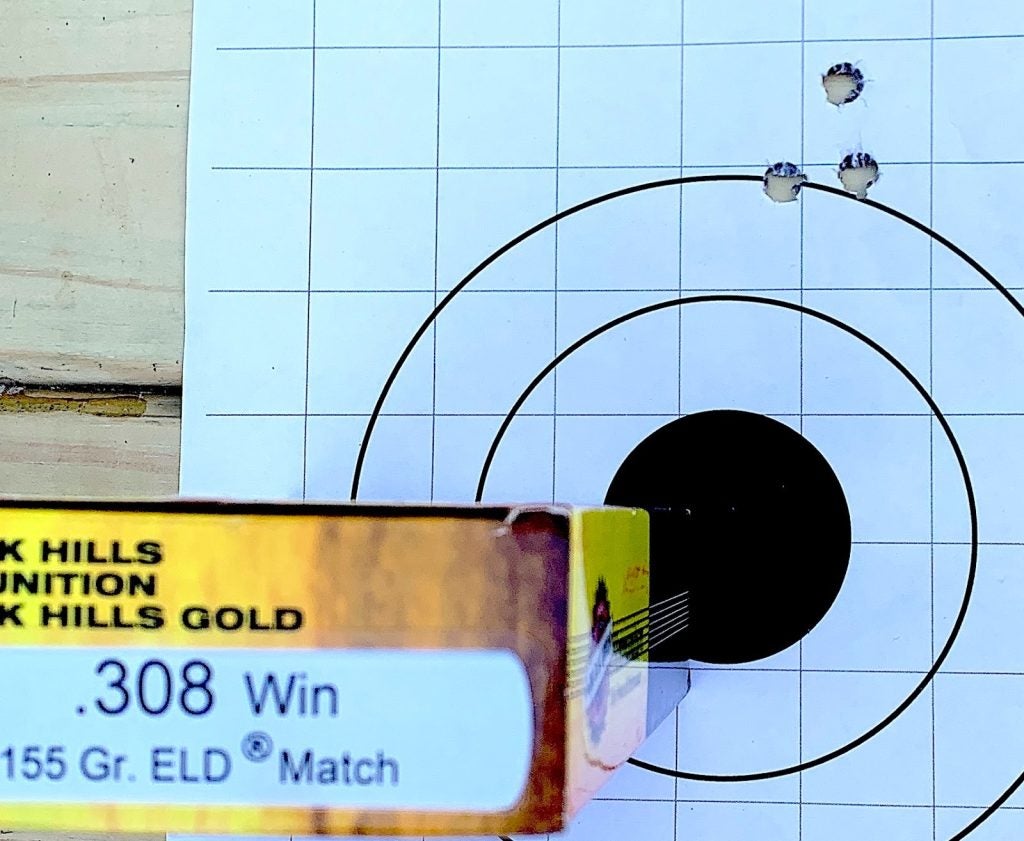
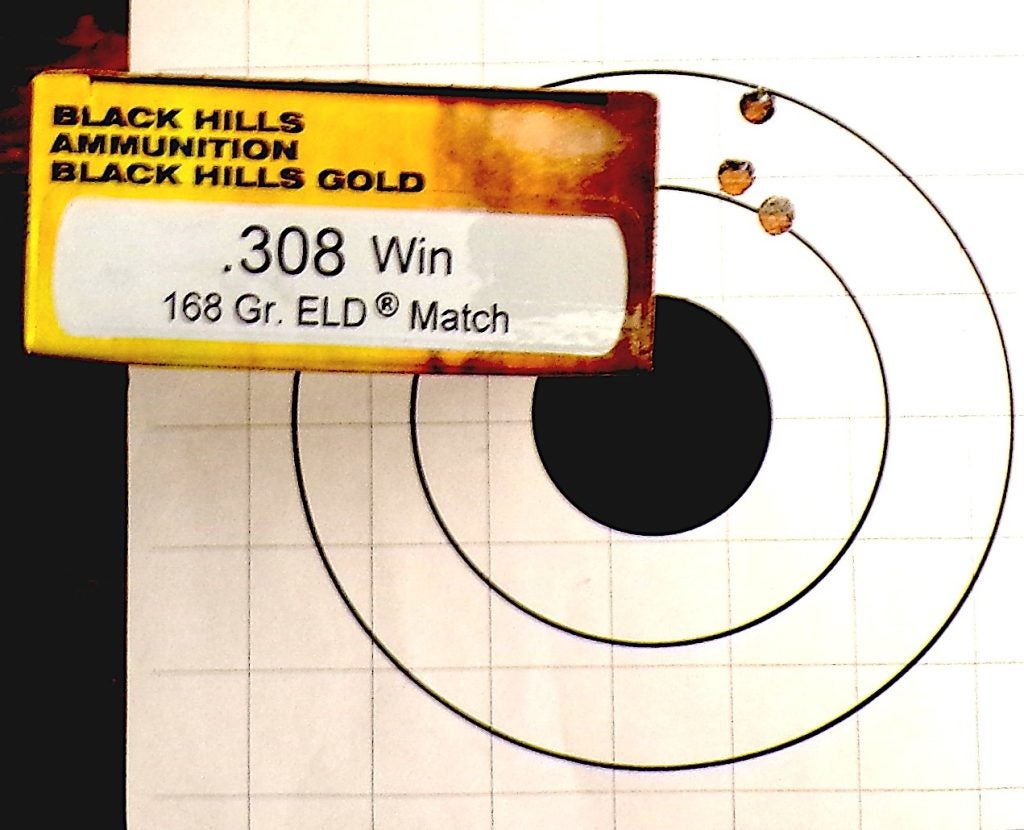
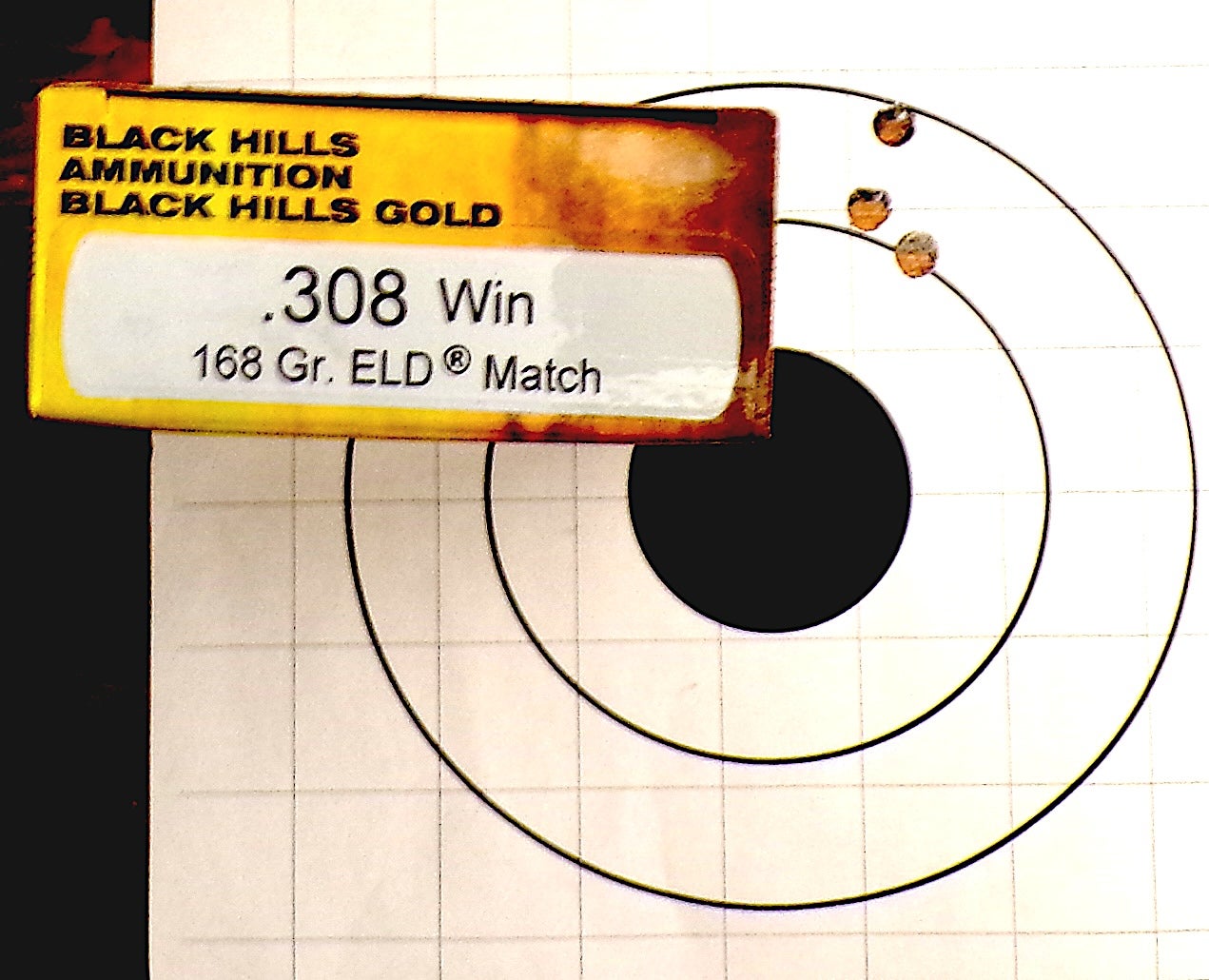
In terms of “shots touching each other”, we see that with the 150- and 165-grain loads. The others weren’t far off and very possibly could qualify the next time I take the rifle out and shoot it. Any of these loads would certainly work for our Hoosier deer woods.
It’s obvious to me that, with about one-inch groups at 50 yards, we’d be right on the accuracy requirement of 2 MOA for Cooper’s Scout rifle concept. Remember, these groups were shot with open sights. Add an optic, and they would tighten up.
One of our sons and I are also inveterate handloaders, and between us, we have a ton of .308 cases, with powder provided by Hodgdon for reloading this and the 5.56mm. (He has the Dillon 750 XL set up for .223, and I am ready with my RCBS Rock Chucker Supreme for .308. I also have a set of .223/5.56 dies ready if needed.)
As soon as I can get to my unheated reloading area, I have CFE223, Varget, and Winchester Sta-Ball Match powders, with bullets provided by Raven Rocks Precision, lined up and ready to go. They supply some very nice bullets and other equipment. (You can read my article about reloading the .277 Fury and the .308 with some of those bullets here.)
As I said, I used the sights that came with the rifle. When the snow abates and I am able to reach my targets out yonder, I’ll put an optic on it of some sort… I think I have one coming in, an LPVO, that would be great. We’ll see if it materializes. At least, we can shoot it now. I most certainly will get it lined out before I do any hunting with it. An illuminated-reticle LPVO is just the ticket… stay tuned. Although for general shooting at my range, the ghost ring/post works fine. Now, if I only find my AR front sight adjustment tool…
We need to remember that the accuracy characteristic of the Scout concept is 2 MOA, not 1. This rifle should easily meet that criteria, especially when given better shooting conditions.
Do You Need This Rifle?
I love asking that rhetorical question when I review something off the beaten path. I usually like to answer it in the affirmative… of course you do! Well, let’s qualify that a bit. If you like the .308 caliber in a bolt-action rifle, and you are looking for something really handy to carry around, then you will want to look at this rifle.
It is the embodiment of Cooper’s Scout concept, built with those characteristics firmly in mind. Having it built on Ruger’s Gen II American platform is even better, with the improved adjustable trigger, a buttstock that can be shortened for shooters of smaller stature, and a snap-on comb height adjuster. (I admit that I like the way the black comb adjuster looks on the green rifle stock… mine will stay there. It will become very useful when I put an optic on the gun.)
Another plus is the threaded muzzle – now that suppressor sales are going through the roof, you might want to think about adding one. Even something simple like the built-in sling swivel studs adds to the value. If I were a betting man, which I’m not, I’d bet that Ruger sells a whole lot of these. It’s a nice, handy rifle that performs.
Links To Items Used In This Review
- Birchwood Casey Filled Shooting Bags, $40
- Birchwood Casey Range Cleaning Kit, $60
- Black Hills Ammunition
- Caldwell E-Max Low-Profile Hearing Protectors, $33
- Caldwell Max-Grip Slim Sling, $31Caldwell Ultimate Target Stand, $33
- GPS Medium Range Bag, $150
- Wheeler Firearm Accurizing Torque Wrench Kit, $88
- Wheeler Trigger Pull Gauge, $88
- Wheeler Red Laser Bore Sighter, $193 (available in green, also)
Read the full article here