
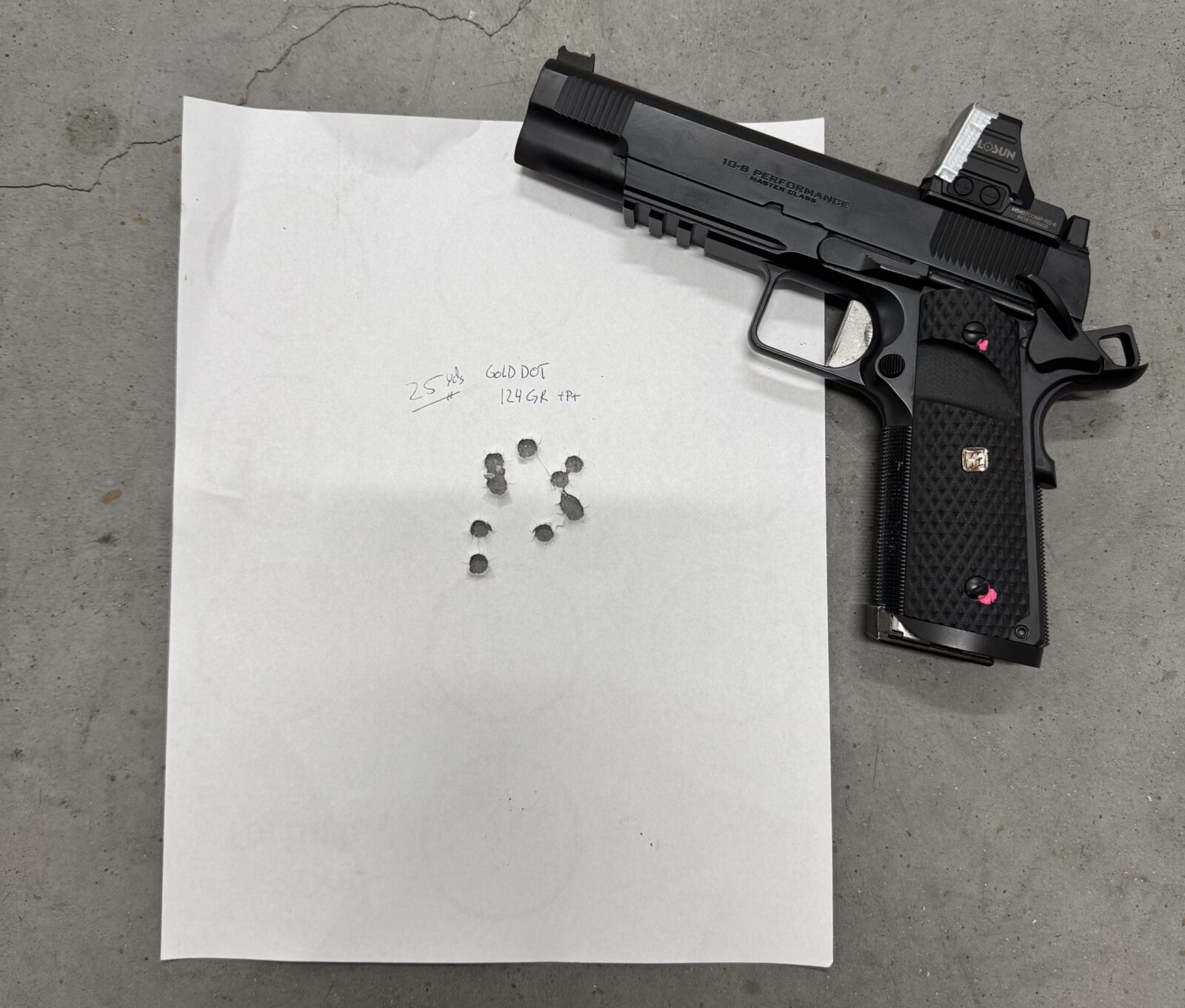

At the time of writing, the Springfield Lipsey’s Exclusive 10-8 Performance Master Class has fired just over one thousand rounds.
A Return to the Platform
I have been carrying the 10-8 Master Class full-time since my first impressions, shooting it almost daily. I like to use the first thousand rounds as a “get to know you” stage to really figure a gun out. Coming from a 12 oz J-frame, I’ve been spending a bit more time dry-firing the 10-8 to adjust to the platform. I have been a “1911 guy” for as long as I’ve been a “gun guy,” but it has been almost six years since I spent any real time with one.
Lately, I noticed I was treating my carry guns less like a hobby and more like a tool. While viewing a gun as a tool is a totally appropriate outlook, I’ve realized I need to stay excited and interested to remain engaged with my training. Since carrying the 10-8 full-time, I’ve found that spark again. I now spend most of my lunches on the range, running drills and working with a shot timer.
Performance and Shootability
In terms of shootability, calling the 10-8 a “modernized 1911” does it a disservice; it is better described as a single-stack 2011. I have been pleasantly surprised by how this gun performs. It can be hard to quantify the sensations of recoil, but the 10-8 feels closer to a 2011 than a traditional 9mm 1911. The internal lightening done at the factory, combined with the bull barrel, results in tracking that mimics a modern 2011.
Traditional 5-inch bushing-barrel 1911s can feel a bit like a rowboat under recoil—the muzzle lifts off-target and then dips below the point of aim on the return. The 10-8, however, returns exactly where it started, shot after shot.
Ergonomics and Controls

There is nothing on this gun that makes it unpleasant to shoot for long periods. The billet ambi thumb safety is a massive improvement over past versions; it is chamfered and radiused so well that I plan on keeping the stock safety installed. While controls can sometimes seem ornamental, the suite of 10-8 Performance parts is well-thought-out and of the highest quality.

The signature “scoop” grips, extended magazine release, Gen 2 slide stop, and magwell all work in harmony to make reloading easier—which is vital, because with a single-stack, you’ll be reloading quite frequently.
If you have never felt 20 LPI (lines per inch) checkering, you don’t know what ‘aggressive’ actually means. I had to work with the 10-8 frequently just to let my hands toughen up. When I first took it to the range, my hands were sore after barely 100 rounds. One thousand rounds in, I can now get through a few hundred comfortably since I’ve developed some callouses. The Signature Series grips provide the perfect texture for my hands, yet I don’t notice them rubbing or snagging as I go about my day.
Some Issues
Saying I love this gun would be an understatement, but I am still compelled to share the issues I’ve encountered over the last thousand rounds.
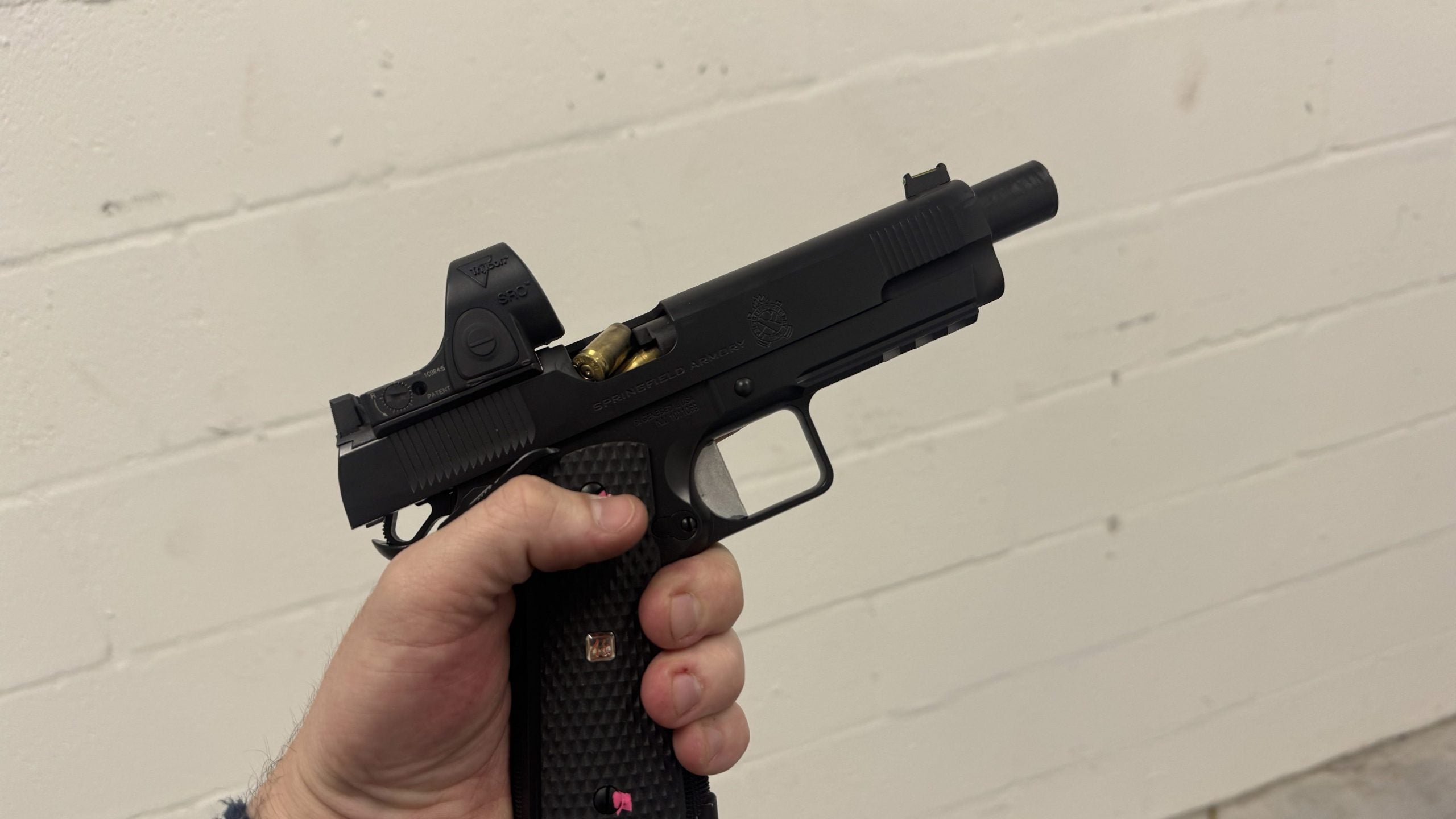
- Stoppages: The 10-8 Master Class had two stoppages: one failure to go into battery and one failure to extract. Both happened during the same range trip. I believe the Cerakote may have been slowing the slide down enough to affect reliability with weaker 115gr ammo. After 400 rounds, the slide felt a little sluggish, so I wiped the rails down. This seemed to clear out a fair amount of excessive Cerakote, and the gun has not had a stoppage since.

- Optics: The AOS plate came loose during a string of fire. I have since thoroughly cleaned the screws and threads, applying a high-quality thread locker rather than relying on the pre-applied compound provided with the hardware. My hope is that with this extra care, the mount will remain rock-solid. The resulting “whiplash” from the loose plate potentially killed the SRO I had mounted. I have since switched to the new Holosun 507 Comp and will move the SRO to another project once it returns from RMA at Trijicon.
- Note: Some 1911/2011s do not play nice with the SRO, as the objective lens can overhang the ejection port. This overhang may very well have been the culprit for the failure to extract mentioned earlier.
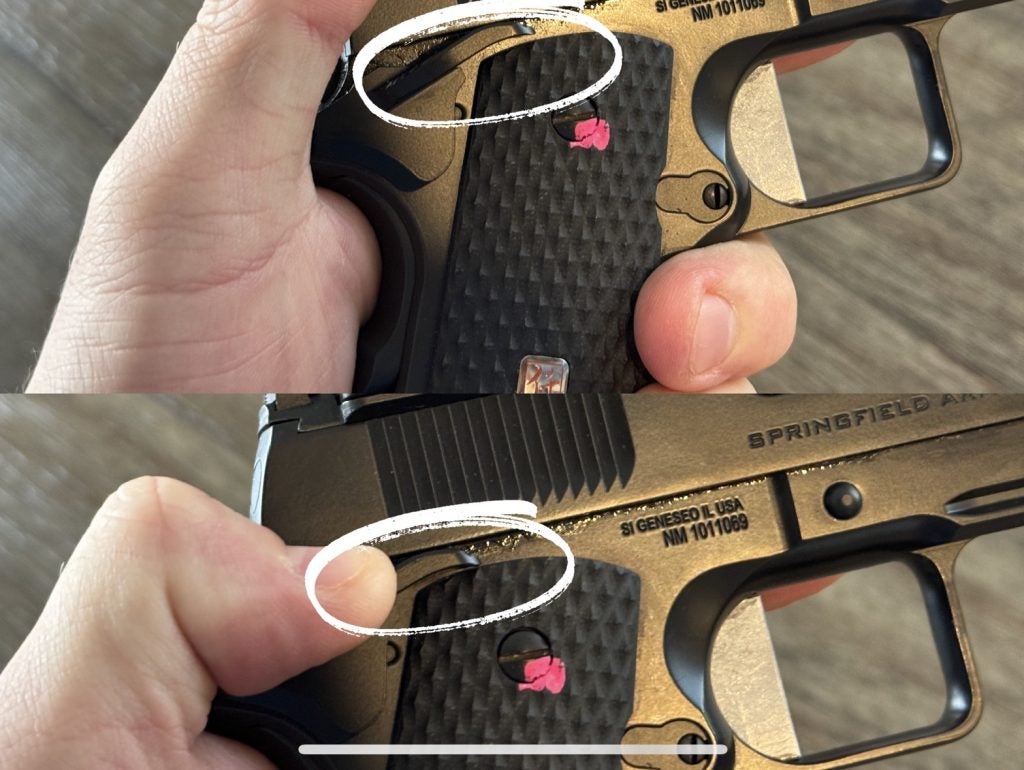
- Safety Play: While the thumb safety profile is excellent, this specific example has loosened up with relatively limited off-hand use. The right-hand side has considerably more play than the left, and both sides exhibit “dip”—meaning the safety can be pressed further down than necessary, leading to a mushy sensation.
- Front Sight: The green fiber optic was very loose out of the box and would have certainly fallen out had I not addressed it myself with a lighter.
- Ignition: The pistol comes factory-installed with a titanium firing pin, which struggled to ignite ammunition with hard primers. After experiencing light strikes with Monarch and Scorpion 115gr, I switched to a “Bullet Proof” steel firing pin, which immediately solved all ignition issues.
Finally, as expected, the Cerakote has worn away on the slide rails. This has resulted in a slightly looser slide-to-frame fit—nothing surprising for a gun being used as a hard-working tool rather than a safe queen.
Finally, as expected, the Cerakote has worn away on the slide rails, resulting in a slightly looser slide-to-frame fit—nothing surprising for a gun being used as a hard-working tool.
Read the full article here
